Wind-tunnel page of Petra Kastner-Klein
email: pkklein@ou.edu
Wind-tunnel page of Petra Kastner-Kleinemail: pkklein@ou.edu
|
|

|
|
|
|
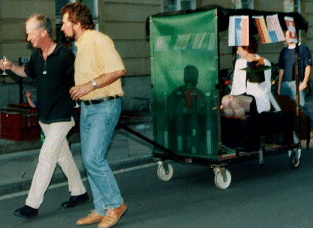
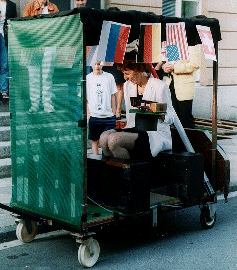
I am sitting in a model of
the Atmospheric
Boundary Layer Wind Tunnel which I used for my studies and
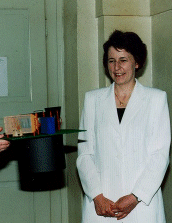
also the hat is decorated with a small really working wind tunnel.
The topic of my thesis was Experimental investigation
of fluid mechanical transport processes in street canyons.
That is the reason why my chair corresponds to a model
of street-canyon buildings. |
|
|
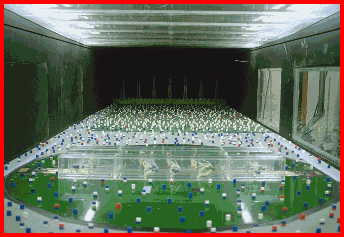
The photo to the right gives you an impression of the experimental set up during my street-canyon studies. You see the wind-tunnel model of an idealized street-canyon configuration mounted in the Atmospheric Boundary Layer Wind Tunnel. The two buildings are surrounded by homogeneously distributed roughness elements which are important for the simulation of a boundary - layer flow similar to the atmospheric boundary layer. Additionally vortex generators are installed at at the entrance of the wind-tunnel test section. The ceiling of the tunnel can be adjusted to avoid pressure gradients. |
|
|
The idea of the experiments was to study the influence of small-scale parameters describing the building configuration, like e.g. building dimensions or roof geometry, on flow field and dispersion inside the canyon. A tracer gas was released by two line sources. The basic configuration was characterized by two 12 cm high buildings with flat roof and perpendicular approach flow. The buildings were 180 cm long, which means their horizontal extension was up to the tunnel walls. Additionally an inflow at the lateral street edges was blocked by plates. In this case two dimensional flow patterns could be observed in the central region. The width of the street was 12 cm, which means the aspect ratio, defined as height of buildings to width of street , was one. The length and width of buildings, number of buildings, roof geometry and wind direction were varied. |
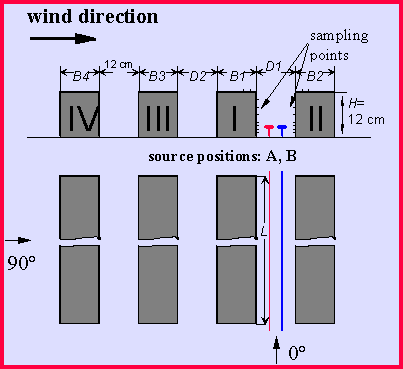
|
|
I found that small-scale
features of the building configuration have a strong influence on flow field
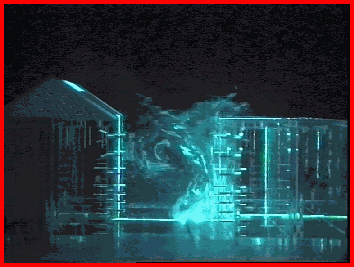
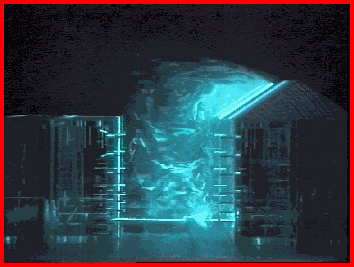
and dispersion inside the street canyon. The photos to the right
give an impression on the changes of the vortex dynamics. They result
from laser light sheet visualizations which I made for different
roof configurations. The smoke was released near the ground and the light
sheet was placed in the central plane. The wind is blowing from
the right to the left. For situations with perpendicular approach flow a vortex
rotating in the street can be usually observed (upper photo). This
type of flow occurred for situations with flat roofs at the upstream
building (right building on the photo) and no step-down. The lower photo
shows a significant change if a slanted roof is placed on the upstream
building but similar effects were also found for several other
step-down situations. No clear rotating vortex forms and the region polluted
with smoke is much higher. |
|
|
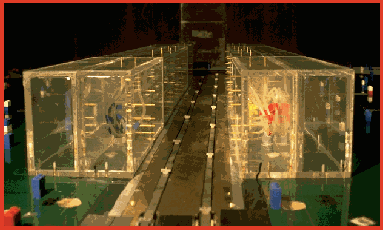
Vehicle-induced turbulence can be an important factor of pollutant dispersion in urban areas. But there is only little information on the quantitative effect and methods to include this parameter in dispersion models. This was the motivation for a wind-tunnel study with emphasis on influence of vehicle motions on the dispersion characteristics inside street canyons. Based on a similarity concept proposed by E.J. Plate (1982) a modeling technique was developed. The experimental setup is shown on the photo to the right. The motions of vehicles are simulated by small metal obstacles which are mounted on belts. They generate turbulence on a characteristic scale related to the obstacle geometry. |
|
|
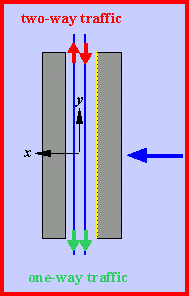
We modeled two traffic
lanes by two belts, which can move with different velocities and
and in different directions. Situations with two-way traffic as
well as one-way traffic could be studied. |
|
|
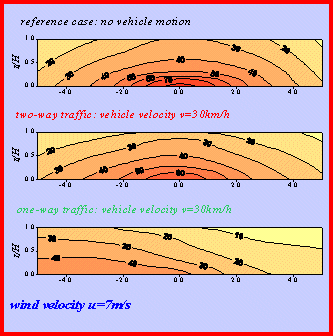
The results for the reference case (without traffic), are shown in the upper plot. In this case the flow characteristics are determined by the interaction of a canyon vortex and vorticity zones near the building edges. The pollutants are transported to the leeward canyon wall where a three-dimensional, symmetric concentration pattern was observed. The maximum concentration was found in the canyon center near the ground. For the two-way traffic situation similar results were found. The moving traffic did not essentially affect the concentration pattern, but the maximum concentration was lower than in the reference case. In the case of a one-way traffic situation the concentration field changes fundamentally. The moving traffic leads to a pronounced transport of pollutants along the canyon axis. The concentration pattern at the leeward canyon wall is no more symmetric and the point of maximum concentration is shifted to the canyon end. Systematic studies for situations with two-way traffic showed that the maximum concentration decreases with an increasing ratio of vehicle to wind velocity and with an increase of traffic density in the case of perpendicular approach flow. A dimensionless combination of vehicle to wind velocity ratio and density factor was proved to be a universal parameter describing the dependence of concentration on vehicle-induced turbulence. |
|
More information is available in a number of publications. The
references are given in pkklein-publis.pdf
You may also visit the Homepage of the TRAPOS Working
Group "Traffic Produced Turbulence"

|
Wind-tunnel laboratory at the University of Karlsruhe |
|
|
The physical modeling group at the Meteorological Institute, University of Hamburg |
|
|
The Wind Engineering and Fluids Laboratory at Colorado State University, Fort Collins, Colorado |
|
|
TRAPOS: Optimisation of Modelling Methods for Traffic Pollution in Streets |
|
|
bwplus: Forschungsförderprogramm Forschungszentrum Karlsruhe, download of relevant research reports possible (in German). |
|
|
Urban Climate: You can find information about addresses, literature, companies and meetings. In addition you can find a list with interesting homepages about Urban Climates and information about urban climate from cities all over the world. The Homepage is hosted at the Meteorological Institute of the University of Freiburg, Germany. |
|
|
COST 715: Meteorology applied to Urban Air Pollution Problems |
|
|
COST 710: Harmonisation in the pre-processing of meteorological data for dispersion models |
last modified: 11/11/2002 by Petra Kastner-Klein
 It is an old tradition that the colleagues create a kind
of vehicle and a hat for the Ph.D. candidate with some features relevant
to the work, behavior.... of the candidate. After you passed the exam
the next one starts: You have to survive being transported around the
campus!!
It is an old tradition that the colleagues create a kind
of vehicle and a hat for the Ph.D. candidate with some features relevant
to the work, behavior.... of the candidate. After you passed the exam
the next one starts: You have to survive being transported around the
campus!!