Matlab Assignment 1
Brett Roberts
September 26, 2006
Part 1
Question 4
T700 = 268.57 K, T500 = 251.92 K
(U.S. standard
atmosphere)
Tavg = (268.57 K + 251.92 K) / 2 = 260.25 K
Hypsometric Equation:
z2 - z1 = (Rd/g) * Tavg *
ln(P1/P2)
Thickness = [(287 J K-1 kg-1) / (9.8 m
s2)] * (260.25 K) * ln[(700 hPa) / (500 hPa)]
Thickness = 2564.5 m
Question 5
z700 = 3012.18 m, z500 = 5574.43 m (U.S. standard
atmosphere)
Thickness = 5574.43 m - 3012.18 m = 2562.3 m
The difference in height given by the hypsometric equation is slightly
different than that given by the U.S. Standard Atmosphere calculation.
This is to be expected because the temperature used for the hypsometric
calculation is a simple average of the two levels, while the standard
atmosphere is based on more accurate calculations. Also, the hypsometric
equation uses actual heights, whereas the standard atmosphere uses
geopotential heights.
Figure 1:
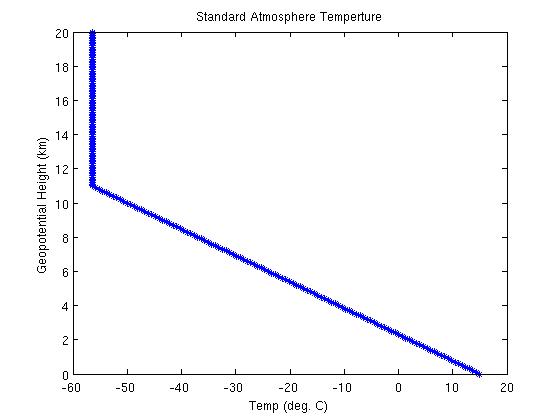
Figure 2:
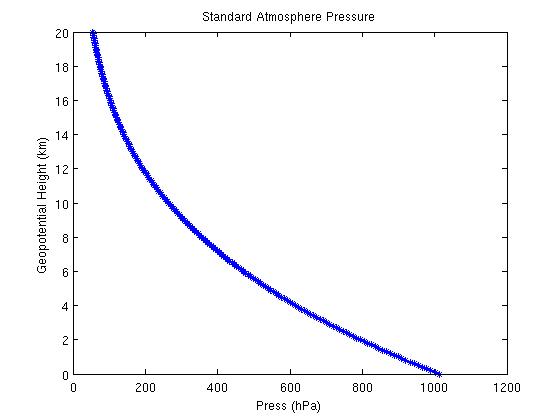
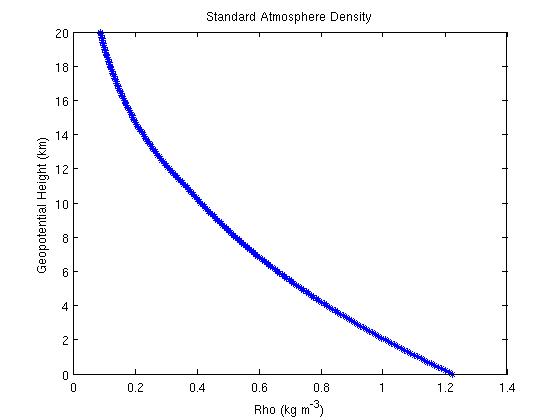
Figure 3:
Part 2
Question 4
The fact that the semilog plots of pressure and density
are not linear tells us that these quantities do not vary logarithmically
with geopotential height. This means that defining a single scale height
valid over the entire vertical extent of the atmosphere would not be
valid,
because the change in pressure or density corresponding to a decrease of
1/e of the initial geopotential height varies from one initial point to
another.
Question 7
The saturated adiabatic temperature profile matched better with the
profile from the U.S. Standard Atmosphere. The height at which the
temperature begins to increase with height is called the tropopause, and
marks the beginning of the stratosphere. This would correspond to a
negative lapse rate.
Figure 4:

Figure 5:
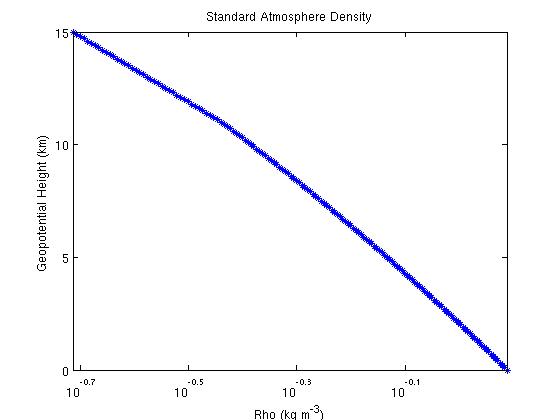
Figure 6:

Back to Main