Fractal Math
Julia Set
The Julia Set is based on the equation:
Z' = Z^2 + C
where Z and C are both complex numbers. Each pixel of the Julia Set
images represents different values of Z(0) - that is the starting point
of the calculation in complex space.
For each starting point, the value of Z after N iterations will ultimately
either exceed a "breakout" value (an unstable case) or remain within the
bounds of the breakout radius (a stable case). Colors are assigned to
the pixel based on either of the two scenarios. These images illustrate
the principles of chaos theory - how a nearly imperceptible perturbation
in initial conditions can lead to a dramatically different final state.
The default program produces the following image:
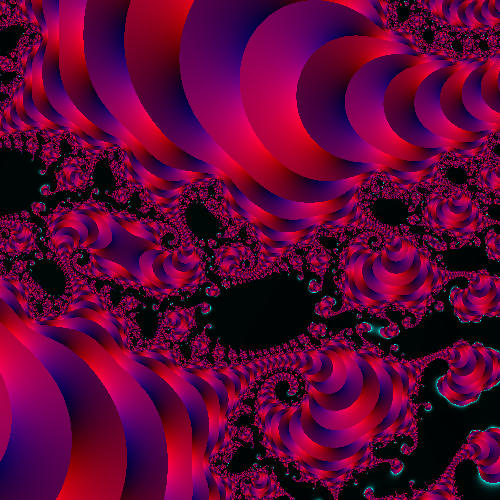
The default code assigns a red/blue value to a breakout (all the purplish
hues), which dominate a large amount of the space in the figure. The
black areas and blueish/grenish hues represent stable initial values
(i.e., that did not exceed the breakout threshold), the latter marking
surprisingly narrow regions where there is a transition to the breakout
regime.
What happens if we double the number of iterations to N=200? We would
expect less initial values to remain stable, given more "time" for the
calculation to exceed the breakout threshold:
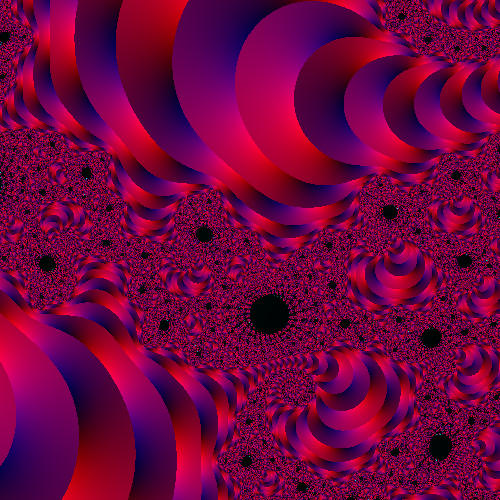
Indeed, this is what happens. The area of stable initial values (black)
decreases. The areas that broke the threshold with N=100 remain.
We can also increase the breakout threshold (here, from 64 to 1,000,000) to
increase the stable area (with N=100):
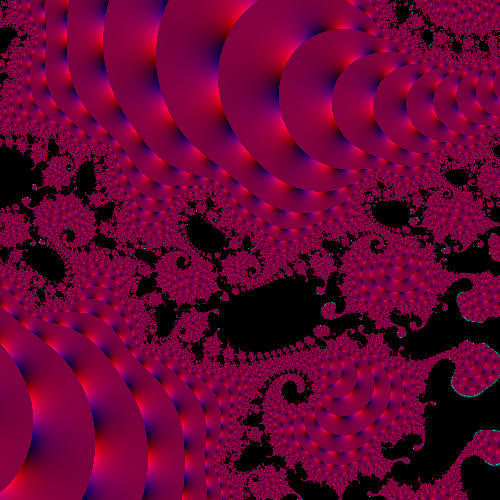
Note that the stable increases very little, even though the break out
threshold has been increased over 4 orders of magnitude!. This implies that
the unstable areas are very much so. The extra folding of the color
scale is simply an artifact of the coding.
Let's try some other equations: