<head>
  <link rel="stylesheet" type="text/css" href="style/menustyle.css" />
  <title>Research</title>
  <meta http-equiv="content-type" content="text/html;	charset=utf-8">
	<meta name="author" content="Ryan May">
	<meta name="robots" content="all">
	<meta name="description" content="My Curriculum Vitae">
	<meta name="keywords" content="Meteorology Radar Weather Python Signal Processing">
</head>
<body>
  <div id="banner">
  		 <h1>Ryan May's Research Page</h1>
  </div>
  
  <ul id="tabmenu">
  	<li><a href="vita.html">CV</a></li>
  	<li><a class="active" href="research.html">Research</a></li>
  	<li><a href="computing.html">Computing</a></li>
  	<li><a href="http://dopplershifted.blogspot.com">My Blog</a></li>
  </ul>

  <div id="content">
    <h1>Radar Emulator</h1>
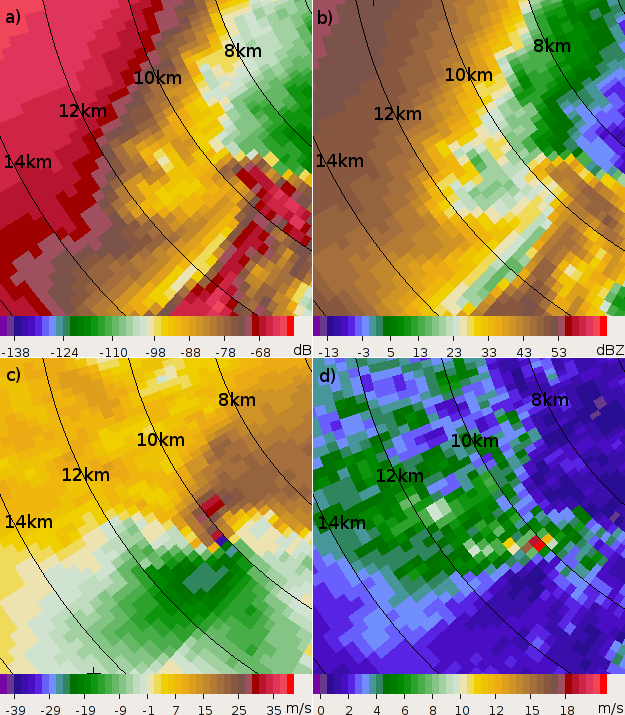
    <p>Thus far the bulk of my research has focused on a software radar emulator/simulator which is described in
    <a href="research/papers/emulator-JTECH-2007.pdf">May et al. 2007</a>.  The initial application focused on
    testing how tornadic signatures in radar data degraded as a function of range and sampling intervals for a
    broad beam radar. An example of the simulated data is shown below.<br>
    <img src="images/4panel-basic-zoom.png" alt="4-panel plot of simulated data"><br>
    The image shows (a)returned power, (b) equivalent reflectivity factor, (c) Doppler Velocity, and (d) Doppler Spectrum Width
    for a WSR-88D type radar.</p>
    <p>Current work on the emulator includes adding full time-series simulation as well as an upgrade on the scattering
    model from the Rayleigh assumption to a full scattering calculation that allows for non-spherical particles as well as
    resonance effects.  Currently, T-matrix and Discrete Dipole Approximation methods are being evaluated.</p>
  </div>
</body>