Our experiments are performed using the sensitivity-enhanced code generated from Version 4.0 of the ARPS, which is three dimensional, fully compressible, and nonhydrostatic. The prognostic variables, solved on the Arakawa C grid [1], include Cartesian velocity components, perturbations of potential temperature and pressure, mixing ratios of water vapor, cloud water, and rain water, and turbulent kinetic energy. The advective modes are computed on large timesteps with a leap-frog time scheme and second-order centered space differencing, whereas the acoustic modes are integrated on small timesteps with an implicit scheme. Kessler-explicit warm-rain microphysics is employed [12]. An extensive description of the model can be found in the ARPS users guide [22].
The computational domain
consists of  grids in the horizontal with a grid size of 1 km. In
the vertical, a stretched grid system is employed for 35 grids with a
resolution of 150 m near the ground and 850 m at the top of the model
domain. The model is run for 140 min, with a large timestep of 6 sec and
a small timestep of 1 sec. The detailed model configuration for our
experiments is described in [15].
grids in the horizontal with a grid size of 1 km. In
the vertical, a stretched grid system is employed for 35 grids with a
resolution of 150 m near the ground and 850 m at the top of the model
domain. The model is run for 140 min, with a large timestep of 6 sec and
a small timestep of 1 sec. The detailed model configuration for our
experiments is described in [15].
The simulation to verify the
computation of derivatives by ADIFOR is made by using the HALF4
(supercell) hodograph and thermodynamic sounding from [7],
the latter of which has a surface mixing ratio of 15 g/kg.
This wind profile consists of a semi-circular arc of 10 m/s
radius that turns clockwise over the lowest 4 km starting with the
surface easterly winds. The (westerly) wind is constant, with height
above 4 km at a speed of 10 m/s. The convection is initiated by a 4 K
thermal perturbation placed in the boundary layer. The simulated
supercell develops rapidly during the first 30 minutes and becomes
quasi-steady thereafter, with a sustained updraft of around 47 m/s.
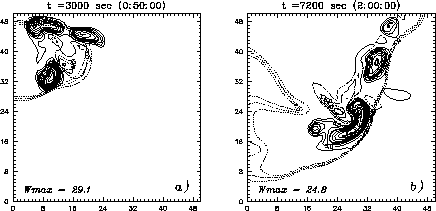
In Figure 1, the surface outflow boundary velocity and vertical velocity at 4 km
are depicted for t = 50 and 120 min. The storm moves to the west
initially and then turns northeastward as it grows in vertical extent,
forming a strong surface cold pool.